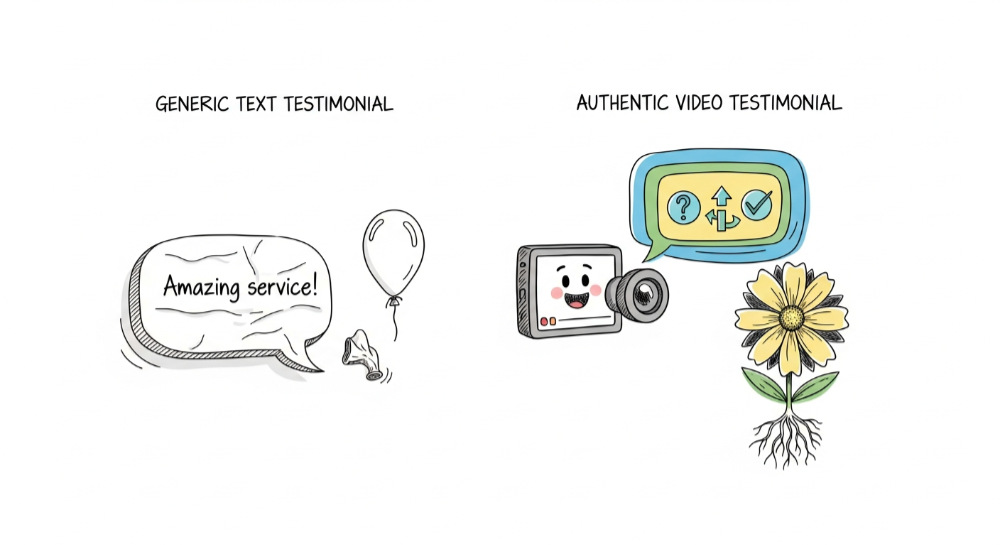
You have testimonials, but they aren't converting and the reason is almost always the same: the testimonials are too vague to be believable.
"Amazing service, highly recommended."
"Changed my life."
"10/10 would buy again."
These are compliments, not proof. A skeptical buyer reads them and thinks that this could have been written by anyone, about anything. The doubt remains. They leave.
Vague trust is weak trust. A stranger does not need to know that someone was happy. They need to know that someone with the same exact doubt they have right now took the risk and it worked.
That is a fundamentally different ask – and it requires a fundamentally different approach to collecting, formatting, and placing your social proof.
What is a trust-building testimonial?
A trust-building testimonial is a specific, verifiable account from a real customer that addresses a buyer's hesitation directly – before they have to ask.
It is not a compliment. It is a story: before, turning point, result. The closer it mirrors the skeptical buyer's situation, the harder it is to dismiss.
Why skepticism has gotten harder to overcome
Text is easy to fake. Everyone knows it.
AI-generated reviews, incentivized star ratings, and five-second form submissions have trained buyers to distrust anything they can't verify. They are not wrong to be skeptical. The ecosystem made them this way.
Video has become the new Proof of Life because it is hard to manufacture. The hesitation before the camera, the search for the right word, the genuine reaction – these signals don't exist in typed text. Buyers register them, often without consciously thinking about it.
The data is clear: Wyzowl's research finds that the majority of consumers say watching a video has convinced them to buy a product or service. These numbers are not an argument for video as a nice-to-have. They are an argument for video as the baseline.
For any product that is intangible – a course, a consulting engagement, a coaching program, a digital tool – video testimonials are not optional. The purchase itself is invisible before buying. Video is the mechanism that makes the promise visible.
How to collect testimonials that skeptical buyers actually trust
Step 1: Ask the right question
The question "Can you leave a review?" produces: "Great experience, would recommend."
The question "What were you most unsure about before buying, and what changed?" produces a story.
That story contains the exact objection your next skeptical buyer is carrying – and the evidence that it didn't have to stop them. Ask for stories. Reviews are surface-level. Stories are conversion assets. For specific questions that pull out these stories, see our testimonial questions guide.
Step 2: Capture on video, not text
The same words typed vs. spoken on camera are not the same trust signal.
A written testimonial saying "I doubled my revenue in 90 days" raises a skeptical eyebrow. The same person saying it on camera, pausing to remember the exact number, then laughing because they still can't believe it – that is a different thing entirely.
Get video. Keep it frictionless: one link, no account required, record from any device. Anything that adds steps between "I'd like to leave a testimonial" and "I just submitted one" costs you completions.
Step 3: Tag and organize by buyer type
Not every testimonial belongs everywhere.
Tag by product line, buyer profile, and objection addressed. A testimonial from a solo consultant belongs on your consulting page, next to the CTA for consulting. A student testimonial belongs on the course sales page. A sponsor testimonial belongs on your media kit.
Random testimonials scattered randomly are not proof. They are wallpaper. Specific testimonials placed deliberately are conversion infrastructure.
Step 4: Place at the decision point, not the top of the page
The most important placement question is not "where can I show testimonials?" It is "where does my buyer hesitate?"
The answer is almost always: right before they have to pay.
Put a video testimonial on your checkout page. Testimonials placed at the decision point measurably reduce hesitation — BrightLocal's research shows reviews and social proof are a primary driver of purchase decisions. Build a Wall of Love just before your CTA. Let the last thing a buyer sees before they click "Buy" be someone else who already did – and is glad they did.
Step 5: Keep collecting. There is no finish line.
Trust compounds. Three testimonials outperform one. Twenty outperform three.
Most founders collect a few testimonials at launch, feel satisfied, and stop. That is the same logic as hiring one employee and wondering why the business doesn't scale.
Testimonial collection is infrastructure, not a launch task. Every satisfied client is a potential trust asset. Build the system to capture them automatically.
Which format to use for which situation
| Format | Best For | Trust Signal |
|---|---|---|
| Video testimonial | High-ticket, intangible products | Highest – hard to fake |
| Audio testimonial | Camera-shy clients, podcast audiences | High |
| Written quote | Quick reinforcement in email, ads, headers | Medium |
| Case study | Long B2B sales cycles | High – different buyer type |
| Social media screenshot | Organic brand affinity | Medium |
| Star rating aggregates | Baseline credibility, local SEO | Low-medium |
For skeptical buyers evaluating intangible products, video is the minimum viable proof. Everything else is supporting evidence. See real examples in our video testimonial examples collection.
Who needs this most right now
Course creators: You are selling access to a transformation that buyers cannot trial before paying. Video testimonials from students who had your exact results – named, specific, and on camera – are what close cold traffic.
Consultants and coaches: You close referrals at a high rate because trust transfers automatically. Cold prospects do not have that trust transfer. Testimonials are how you replicate word-of-mouth without needing someone to personally vouch for you.
Newsletter operators: Sponsors want proof that your audience engages and converts, not just opens emails. A curated wall of reader testimonials is worth more in a sponsorship pitch than any open rate stat.
Digital product sellers: Your social proof is scattered across Gumroad reviews, Twitter replies, and DMs you forgot to screenshot. Centralize it. An organized, embedded proof layer converts buyers who would have bounced from a page with nothing.
Weak testimonials are the default because collecting strong ones takes a deliberate process. Most founders ask the wrong question, accept a typed sentence, paste it on a page nobody visits, and wonder why it doesn't convert.
The businesses that close skeptical buyers at scale do three things differently: they ask for stories instead of reviews, they capture those stories on video, and they put the video at the exact moment the buyer is deciding.
That is the whole system. It is not complicated. It just requires being deliberate about it.
If you have satisfied clients, you have everything you need. You just need a system to capture it and put it in front of the right buyer at the right moment.
Say About Us gives you unlimited video, audio, and text testimonials, a one-link no-login collection experience, and embeddable Wall of Love widgets for any website.
Start collecting Testimonials with Say About Us on the free plan — no credit card required.
 Ask ChatGPT
 Ask Claude
 Ask Perplexity
 Ask Grok