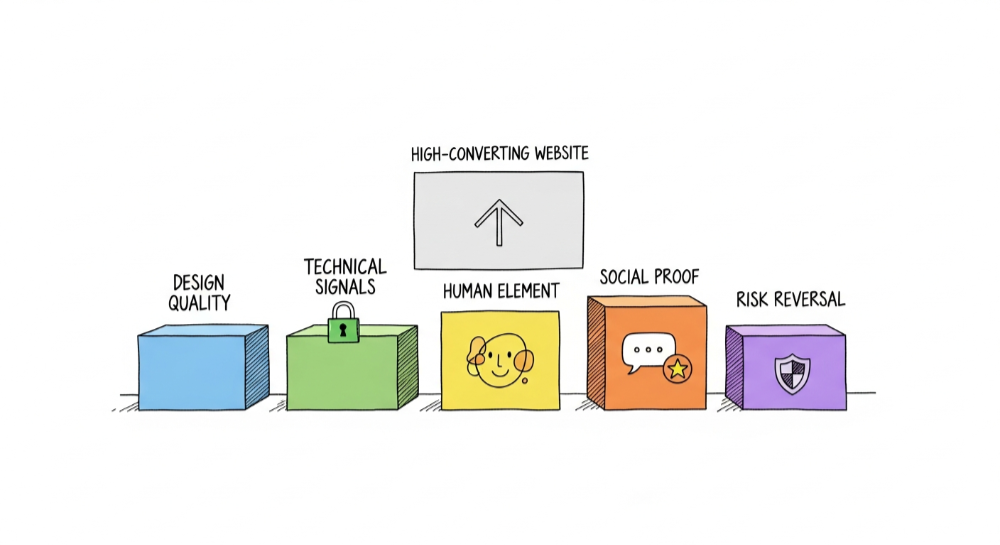
Testimonials are critical, but they are just one pillar of a trustworthy site. If you have great reviews but your website looks "broken" or shady, people still won't buy. To win in 2026, you need a holistic website trust framework.
The 5 Pillars of Website Trust
1. Design Quality (The First Impression)
People judge books by their covers. If your spacing is off, your images are blurry, or your fonts clash, users subconsciously assume your product is low quality too.
Quick checklist:
- Consistent spacing and margins
- High-resolution images (no pixelation)
- Readable font sizes (16px minimum for body text)
- Clear visual hierarchy
- Professional color palette
You don't need to be Apple, but you need to be clean. A polished $20 template beats a messy custom design.
2. Technical Signals
These are the basics that users notice subconsciously:
| Signal | Why It Matters |
|---|---|
| HTTPS | Chrome shows "Not Secure" without it — instant trust killer |
| Speed | A slow site feels abandoned or scammy |
| No broken links | Dead links suggest nobody maintains this site |
| Working forms | If your contact form breaks, what else is broken? |
Quick audit:
- Run your site through PageSpeed Insights
- Click every link in your footer
- Test your forms with a real submission
3. The "Human" Element
Show your face. Show your team. Stock photos of people shaking hands in a boardroom kill trust.
What builds human trust:
- Real photos of your team (even casual ones)
- A founder story or "About" page with personality
- A physical address (even if it's just a city)
- Direct contact options (not just a form)
What kills it:
- Generic stock photos
- No names or faces anywhere
- "Contact us" with no response for days
- AI-generated profile pictures
4. Social Proof (The Core)
This is where testimonials fit in. You need three layers:
Logos: "Used by..." or "Featured in..."
- Shows you are not a complete unknown
- Works even without detailed testimonials
Numbers: "1,000+ users" or "500+ projects completed"
- Quantifies your track record
- Creates FOMO (others trust you, why don't they?)
Stories: The actual testimonials
- Specific results from real people
- Video testimonials are the gold standard
- Build a Wall of Love to display them
5. Risk Reversal
Every purchase is a risk. Your job is to remove it.
Effective risk reversals:
- "Cancel anytime"
- "30-day money-back guarantee"
- "No credit card required for trial"
- "Free tier available"
Where to place them:
- Next to pricing
- On checkout pages
- Near CTAs
The more expensive or complex your product, the stronger your risk reversal needs to be.
How Long Does It Take to Build Website Trust?
Trust isn't built in a single visit — it's built in the pattern of signals a visitor sees. But the good news is you don't need years to start converting. Here's the realistic timeline:
- Immediately: HTTPS, working forms, and a clean layout remove the "is this a scam?" doubt in the first seconds.
- Within days: adding 3-5 specific testimonials with real names near your CTAs changes the conversion story on most pages.
- Within months: a consistent stream of new proof — fresh testimonials, logos, numbers — compounds into the default "these people are legit" assumption.
The framework above isn't a one-time project. It's a baseline you set once and maintain. The sites that win aren't the ones with the most impressive single signal — they're the ones where no signal is missing.
The Trust Audit Checklist
Run through this before your next launch:
- Site loads in under 3 seconds
- HTTPS enabled
- No broken links
- Real photos of team/founder
- At least 3 testimonials visible
- Contact information is clear
- Risk reversal near pricing
- Social proof on homepage
A great testimonial on a broken website is useless. A great website with no testimonials is empty. You need both to win.
Dive deeper into the psychology with our guide on how testimonials increase trust. For examples of high-converting social proof, browse our testimonial examples guide.
Want to audit your website's credibility? Check out our Website Trust Score Guide and use our free Trust Score Checker tool.
Start collecting Testimonials with Say About Us on the free plan — no credit card required.
 Ask ChatGPT
 Ask Claude
 Ask Perplexity
 Ask Grok