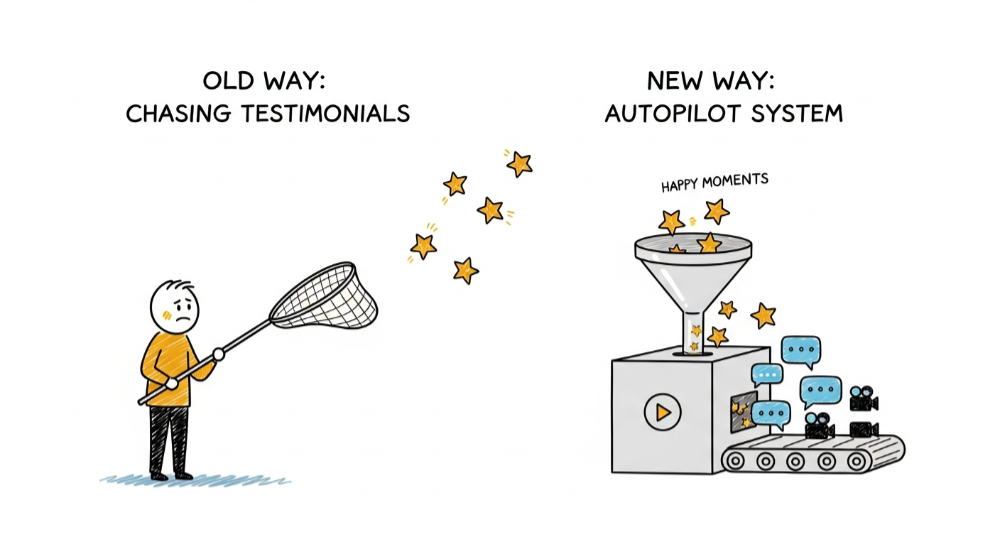
Collecting testimonials without chasing people is a system, not a personality trait. The businesses that always have fresh social proof didn't get it by being pushy — they built a trigger-based pipeline that asks customers at the exact moment they feel most satisfied, then makes the ask so easy that saying yes is less effort than saying no.
Here's the uncomfortable truth: companies that ask for testimonials at the right moment get dramatically higher response rates than those that fire generic requests at random intervals. And most of them never send a second "please?" email — because they don't have to. BrightLocal's research backs this up: most consumers say they'll write a review if asked — they just need to be asked at the right time.
This guide walks through a simple four-step method to collect testimonials on autopilot, with the exact scripts, timing, and tools you need.
Why Chasing Testimonials Fails
Chasing feels bad because it is bad — for everyone. When you nag customers for reviews:
- You feel awkward, so you ask less often and get fewer results
- Customers feel pestered, which quietly damages the relationship you're trying to monetize
- The timing is wrong — most "reminder" emails go out weeks after the moment of satisfaction passed
The alternative isn't asking harder. It's asking smarter: at the right moment, with a one-click ask, on a repeatable schedule.
The 4-Step Autopilot Method
Here is the "Low Friction" method to filling your Wall of Love.
Step 1: Identify the "Happy Moment"
Do not ask when they sign up. Do not ask when they cancel.
Ask when they get value:
- Did they just export their first video?
- Did they just hit a usage milestone?
- Did they just give you a 5-star rating on a support ticket?
- Did they just complete onboarding or publish their first post?
Step 2: The "One-Click" Ask
Send an email that is short and human.
Subject: "Quick question?"
Body: "Hey, noticed you just hit [Milestone]. That's awesome. If you have 30 seconds, would you mind sharing a quick sentence on how it's going? You can record a quick video here without logging in: [Link]"
The key is the link. A testimonial request generator gives you copy-ready, one-click messages so you never write from scratch.
Step 3: The Incentive (Optional but Effective)
"If you leave a video, we'll feature you on our socials."
For B2B users, the promise of a backlink or exposure is often worth more than a discount code. An incentive isn't bribery — it's reciprocity. You're giving them visibility in exchange for their time.
Step 4: Automate It
Once you know this works manually, hook it up to your email provider.
- Trigger: User hits "Success Event"
- Action: Send "Testimonial Request" email
That's it. You stop chasing. You stop feeling annoying. You just wake up to new video reviews in your dashboard.
What the Right Ask Looks Like (and What It Doesn't)
| Ask | Example | Response rate |
|---|---|---|
| Vague, random | "Would you mind leaving us a review?" | Low — no context, no urgency |
| Generic but timed | "Thanks for signing up! If you have a moment, a review helps." | Medium — better, still passive |
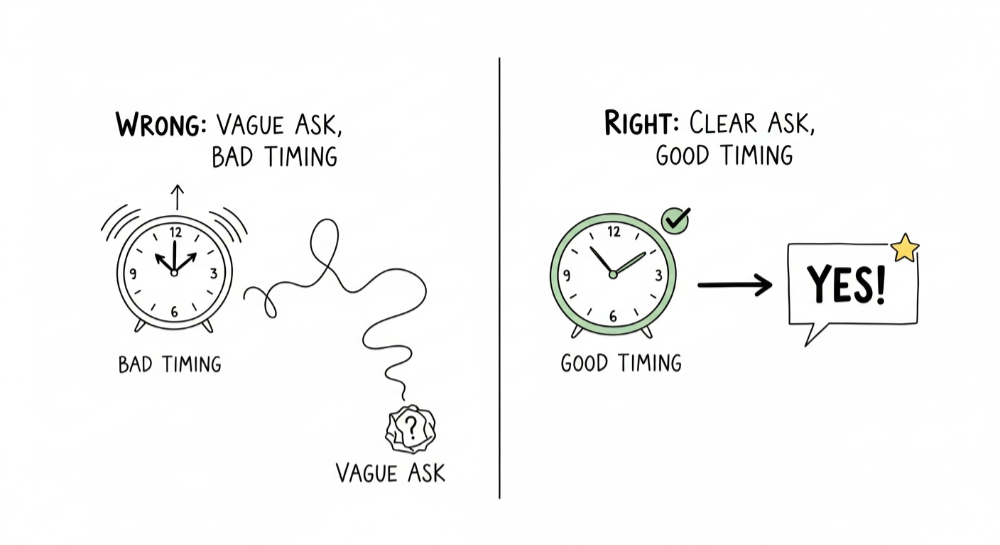
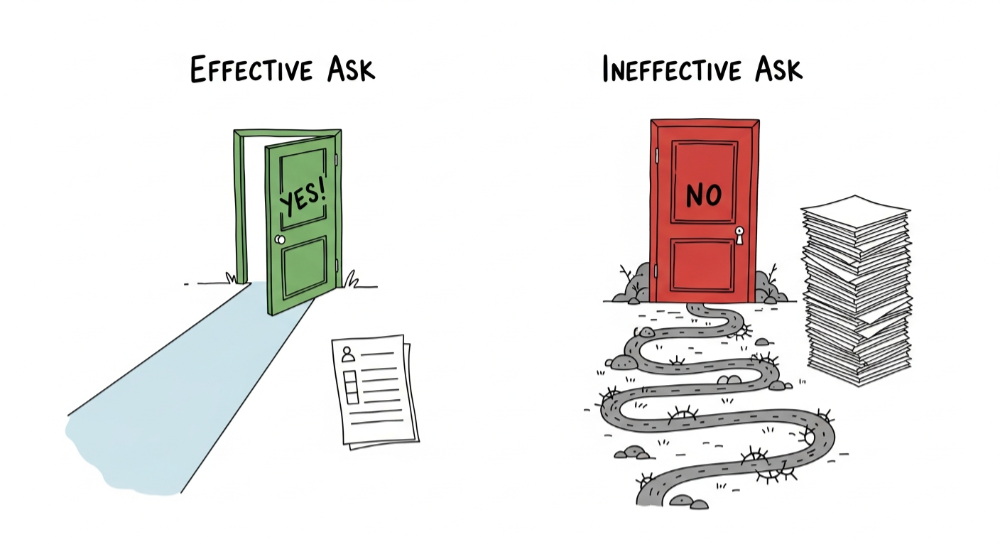
| Moment-based + specific | "You just hit [milestone] — how's it going? 30 seconds here: [link]" | Much higher |
The difference is specificity. A customer who just got value and sees a 30-second ask in front of them will say yes. A customer who gets "please review us" out of nowhere will say nothing.
How Do You Trigger the Ask Without Being Annoying?
The #1 fear people have about automating testimonial requests is that they'll come across as spam. Three rules keep it human:
- One ask, not five. Fire the request once at the happy moment. No follow-up sequence, no "just checking in."
- Make it about them, not you. "Noticed you hit [milestone] — that's awesome" is a compliment, not a solicitation.
- Give them an out. "No worries if you're busy" costs you nothing and keeps the relationship warm if they say no.
If the idea of asking at all still feels awkward, that's normal — but asking for testimonials is a skill, not a personality trait. You get better with practice.
What If You Have No "Success Events" Yet?
If your product doesn't have obvious milestones to trigger on, use the closest proxy:
- Post-purchase confirmation — the customer just committed, enthusiasm is highest
- First value delivery — the moment they receive or complete what they paid for
- Support resolution — a solved ticket is a satisfied customer
- Renewal / expansion — they just doubled down, proof they trust you
Even a simple "Thanks for your order" email with a review link outperforms no ask at all. The method doesn't require fancy tooling — it requires timing.
Start Collecting Without Chasing
The 4-step method takes an afternoon to set up and pays off in every future month. Pick your most common happy moment, write one 30-second ask, and automate it. Then let the testimonials pile up while you sleep.
Use the free Testimonial Request Generator to create your first request in minutes — no chasing, no awkwardness, no cold emails.
Start collecting Testimonials with Say About Us on the free plan — no credit card required.
 Ask ChatGPT
 Ask Claude
 Ask Perplexity
 Ask Grok