If you're trying to decide which types of testimonials to collect, you're asking the right question. Not all social proof is created equal. Some formats build trust faster, convert harder, and give you more leverage across your marketing channels.
This guide breaks down the main types of testimonials, what each one does well, and which format you should prioritize if you're serious about turning browsers into buyers.
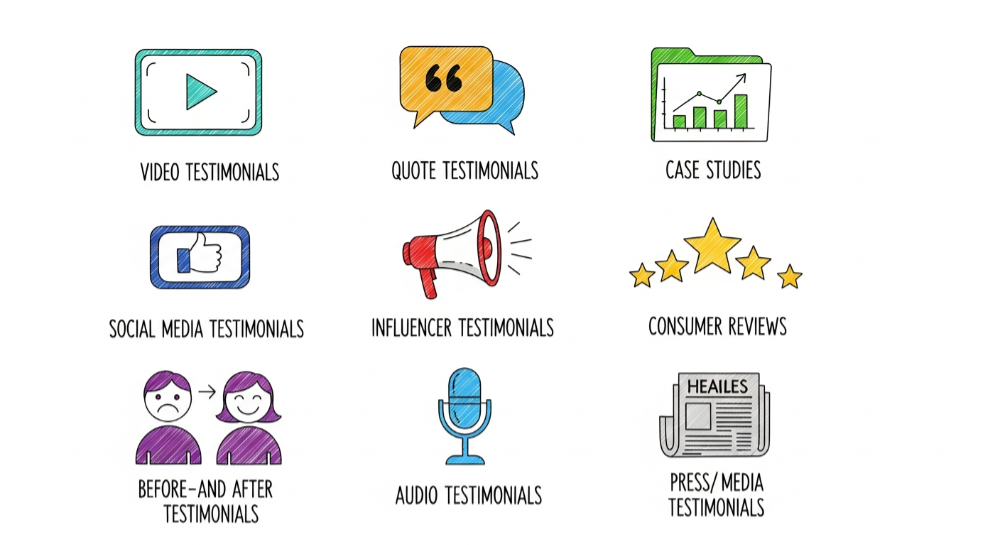
The 9 main types of testimonials
| Type | Effort to collect | Conversion impact | Best for |
|---|---|---|---|
| Video | High | Highest | Landing pages, product pages, ads |
| Written quote | Low | Medium | Supporting proof, emails |
| Case study | High | High | High-ticket B2B |
| Social media | Low | Medium | Brand affinity |
| Influencer | Medium | Conditional | Audiences that trust the name |
| Ratings | Low | Baseline | Credibility, SEO |
| Before/after | Medium | High | Visible transformations |
| Audio | Medium | Medium-high | Camera-shy customers |
| Press/media | High | Authority | "As Seen In" sections |
1. Video Testimonials
The heavyweight champion. Video testimonials let prospects see a real person's face, hear their voice, and feel the emotion behind their words. It's basic psychology. Viewers retain 95% of a message when they watch it in video versus only 10% when reading text.
The conversion data is brutal to an extent that 79% of people say they've been convinced to buy after watching a video testimonial. Another study found that 77% of viewers say a testimonial video influenced their purchase decision.
Some businesses see conversion rate lifts of 34% just by adding customer videos to landing pages. If you only collect one format, make it video.
2. Quote/Written Testimonials
Short, punchy text snippets. Easy to scatter across your website, emails, and ads. They're fast to collect and deploy, but they lack the emotional punch of video. Use them as supporting evidence, not your primary conversion driver.
3. Case Studies/Success Stories
Long-form narratives that walk through problem → solution → results.
Best for high-ticket B2B sales where prospects need detailed proof before committing. These work when your sales cycle is measured in weeks or months, not minutes.
4. Social Media Testimonials
User-generated content pulled from Twitter, Instagram, or LinkedIn. Feels organic because it is your customers posted without any incentive. The downside is that you can't control messaging or format. Use these to show brand affinity, not to close deals.
But if there is a social media post with a video talking about how good your product is, just eat it up for breakfast.
5. Influencer/Expert Testimonials
Endorsements from industry authorities. These work when your audience already trusts the influencer. If they don't recognize the name, this format has zero leverage. Use them sparingly and strategically.
6. Consumer Reviews/Ratings
Star ratings on Google, G2, Trustpilot, etc. These build baseline credibility and help with SEO, but they're passive. Prospects will check them, but they won't drive conversions the way a video testimonial will.
7. Before-and-After Testimonials
Shows the transformation. Works well for fitness, design, financial services and anything where the change is visible or measurable. Can be delivered as text, images, or video.
Video format wins again because you can see the person's reaction to their own results.
8. Audio Testimonials
Voice recordings without the visual element. Easier to collect than video but less impactful. Use these when video isn't possible, like for podcast audiences or when customers are camera-shy. But these are much better than unverified text testimonials.
9. Press/Media Testimonials
Third-party validation from news outlets or industry publications. Strong for building authority but weak for direct conversion. These belong on your "As Seen In" section, not your product pages.
Which types of testimonials should you prioritize?
Video first. Everything else second.
The data makes this clear. 64% of consumers are more likely to buy after watching a video testimonial. That number drops significantly for written testimonials.
Nine out of ten people trust what a customer says more than what you say about yourself, and when that customer is on video, the trust multiplies.
Written testimonials and star ratings are table stakes, you need them for credibility. But if you want to move the conversion needle, you need video testimonials on your landing pages, product pages, and checkout flow.
How to use different types of testimonials together
Don't just collect one format and call it done. Layer different types of testimonials across your funnel:
- Top of funnel (TOFU): Social media testimonials and press mentions build awareness and credibility.
- Middle of funnel (MOFU): Case studies and video testimonials educate prospects and prove your solution works.
- Bottom of funnel (BOFU): Video testimonials on product pages and checkout pages push hesitant buyers over the line. One study found a 20% sales increase just from adding a single video testimonial to the checkout page.
The goal is to match the right testimonial type to the buyer's intent. Someone browsing your homepage needs different proof than someone with a credit card in hand.
Why most businesses get this wrong
Most businesses collect testimonials backwards. They default to written quotes because they're easy to request via email. Then they wonder why conversions stay flat.
Written testimonials are the lowest-effort format for you and the lowest-impact format for prospects. If you want serious conversion lift, you need to collect the formats that require more work upfront but deliver more value on the back end.
Video testimonials take longer to produce, but they work harder. One video testimonial can be repurposed across your website, ads, email campaigns, and sales decks. Written testimonials sit on a page and do nothing else.
The bottom line
Collect video testimonials first. Use everything else as backup.
The conversion gap between video and text is too wide to ignore. If you're spending money on ads or traffic but not collecting video testimonials, you're leaving money on the table.
Which Testimonial Type Should You Start With?
If you're starting from zero, don't try to collect all nine at once. The practical order is:
- Start with written quotes — they're the fastest to collect and give you baseline credibility while you build.
- Add video as soon as you can — even one video testimonial changes the trust story on a landing page.
- Layer in case studies once you have customers with measurable results — they're the heavy artillery for B2B and high-ticket sales.
- Let the rest happen organically — social media praise and press mentions accumulate on their own once you're looking for them.
The goal isn't to have every format. It's to have the right format at the right decision point.
By the way, you can collect text, audio, and video testimonials all in one place with Say About Us. You can also import reviews from social media, G2, and other platforms, plus gather customer star ratings — all on the free plan with truly unlimited testimonials.
Need inspiration for what great testimonials look like? Browse our complete testimonial examples guide with 50+ examples across industries. Or check out our video testimonial examples collection to see the format that converts best.
Start collecting Testimonials with Say About Us on the free plan — no credit card required.
 Ask ChatGPT
 Ask Claude
 Ask Perplexity
 Ask Grok