Try Say About Us — a testimonial collection tool that helps you collect and showcase customer proof.
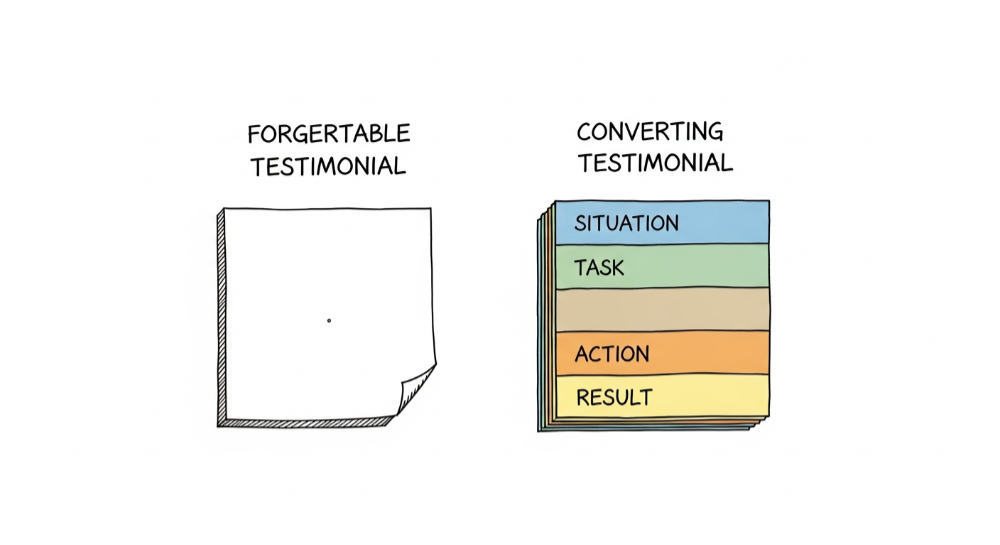
The difference between a forgettable testimonial and one that drives conversions? The questions you ask.
Most testimonials fail because they're vague. "Great service!" doesn't convince anyone. But when a customer describes the specific problem they had, the moment things changed, and the measurable results — that's social proof that converts.
Getting those kinds of responses isn't about luck. It's about asking the right questions.
Why Generic Questions Get Generic Answers
Ask "What do you think of our product?" and you'll get "It's good."
That's not a testimonial. That's a statement that could apply to literally anything.
Generic questions fail because they:
- Don't guide the customer's thinking
- Allow one-word answers
- Miss the story arc (before → after)
- Don't tap into emotional experiences
The solution isn't to ask better questions randomly — it's to use a proven framework.
The STAR Framework for Testimonial Questions
Great testimonials follow a narrative structure. The STAR framework helps you extract it:
S — Situation
What was happening before? What problem existed?
Example questions:
- "What were you struggling with before you found us?"
- "Can you describe the situation that led you to look for a solution?"
- "What wasn't working with your previous approach?"
T — Task
What were they trying to accomplish?
Example questions:
- "What were you hoping to achieve?"
- "What goal were you working toward?"
- "What would success have looked like for you?"
A — Action
What did they do? What was the experience like?
Example questions:
- "What stood out about working with us?"
- "How would you describe the process?"
- "What surprised you about the experience?"
R — Result
What changed? What's measurable?
Example questions:
- "What's different now?"
- "Can you share any specific results or numbers?"
- "How would you describe the impact?"
Questions by Goal
Different goals require different question strategies.
If You Want to Highlight Results
Focus on before/after and specifics.
- "What metrics improved after working with us?"
- "Can you compare where you were before to where you are now?"
- "What's the most significant change you've noticed?"
- "If you had to put a number on the improvement, what would it be?"
If You Want Emotional Impact
Focus on feelings and transformations.
- "How did the problem make you feel before?"
- "What was the moment you realized things were different?"
- "What does this change mean for you personally?"
- "How would you describe the relief of having this solved?"
If You Want to Overcome Objections
Focus on hesitations and why they chose you.
- "What almost stopped you from working with us?"
- "What concerns did you have before starting?"
- "What would you tell someone who's on the fence?"
- "What made you choose us over alternatives?"
If You Want Referral-Worthy Quotes
Focus on who should use your product.
- "Who would you recommend this to?"
- "What type of person or company is this perfect for?"
- "If a friend asked about us, what would you say?"
- "What should someone know before they sign up?"
Industry-Specific Question Banks
For a quick-start list of 30 ready-to-use questions organized by category, see our 30 testimonial questions that actually get good answers.
For SaaS Products
- "How much time does this save you per week?"
- "What were you using before, and how does this compare?"
- "Which feature has had the biggest impact?"
- "How has this affected your team's workflow?"
For Services (Agencies, Consultants)
- "What made you trust us with this project?"
- "How would you describe our communication?"
- "What's the ROI you've seen so far?"
- "Would you work with us again? Why?"
For Courses and Education
- "What could you do after the course that you couldn't before?"
- "What was your biggest 'aha' moment?"
- "How has this knowledge changed your approach?"
- "Would you recommend this to someone in your position?"
For E-commerce Products
- "What problem does this product solve for you?"
- "How does it compare to similar products you've tried?"
- "What compliments have you received?"
- "Would you buy it again?"
The Psychology of Good Questions
Open-Ended > Yes/No
"Was the service good?" gets a yes. "What stood out about the service?" gets a story.
Specific > General
"How was the experience?" gets a platitude. "What surprised you most about working with us?" gets a detail.
Past vs. Present Contrast
Questions that compare before/after naturally create compelling narratives.
Permission to Brag
Many customers downplay their results. Questions that give them permission to share specifics get better answers.
"I know it might sound like bragging, but what results are you most proud of?"
How to Structure a Testimonial Interview
Format 1: Written Questions
Send 3-5 questions via email or form. Best for busy customers.
Example set:
- What were you struggling with before?
- What made you choose us?
- What results have you seen?
- Who would you recommend us to?
Format 2: Live Interview
10-15 minute call, recorded with permission. Best for detailed stories.
Structure:
- 2 minutes: Warm-up and permission to record
- 3 minutes: Background questions (situation)
- 5 minutes: Experience and results
- 2 minutes: Recommendation question
- 2 minutes: Anything else they want to add
Format 3: Hybrid
Start with written questions, then follow up with a call for specifics. Best for high-value testimonials.
Questions to Avoid
Leading Questions
Bad: "Don't you think our service was the best you've experienced?"
Better: "How would you compare our service to others you've used?"
Compound Questions
Bad: "What did you think of the onboarding and the ongoing support and the results?"
Better: Ask each separately.
Questions That Assume
Bad: "How much money did we save you?"
Better: "What impact did this have on your business?"
Too Many Questions
More than 5 written questions reduces response rates. Pick the most important ones.
Getting Reluctant Customers to Open Up
Start with a Compliment
"I noticed you've achieved [specific thing]. That's impressive. Can you tell me more about that journey?"
Share Why It Matters
"We're trying to help others in your situation understand what's possible. Your story could really help someone."
Make It Conversational
"This isn't a formal interview. Just tell me the story in your own words."
Offer to Draft
"If you prefer, I can write something based on what you've told me and you can approve or edit it."
After the Questions: Editing for Impact
Raw answers often need light editing:
- Remove filler words
- Tighten sentences
- Keep the voice authentic
- Always get approval before publishing
Raw: "Um, I guess the thing that really, you know, helped me was that the team was really responsive and they always got back to me quickly, which was nice."
Edited: "The team's responsiveness made a huge difference. They always got back to me quickly."
Same meaning. More impact.
Generate Your Questions
Use our free Testimonial Questions Generator to create customized questions based on your industry, goals, and customer type. Get copy-ready questions in seconds.
Start collecting Testimonials with Say About Us on the free plan — no credit card required.
 Ask ChatGPT
 Ask Claude
 Ask Perplexity
 Ask Grok