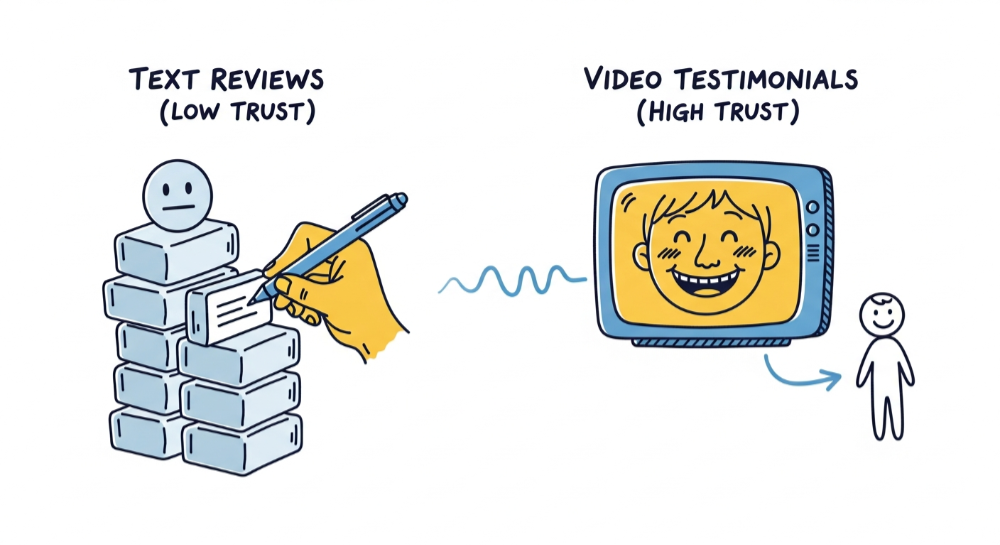
You can write the best copy in the world. You can hire the best designers. But you cannot fake the micro-expressions of a happy human being.
Text is easy to fabricate. We have all seen the fake "John D." reviews on scammy landing pages. Because text is low-effort, it carries low trust.
Video is different. It triggers a psychological response that text never will.
The Mirror Neuron Effect
When we watch someone smile or speak passionately, our brains mirror that emotion. It is biological.
If a customer on video looks genuinely relieved that your software solved their problem, your prospect feels that relief too. You cannot achieve that emotional transfer with a five-star graphic.
What triggers mirror neurons:
- Genuine smiles (not forced)
- Emotional pauses when recalling results
- Body language that shows excitement
- Eye contact with the camera
This is why scripted testimonials feel "off." The brain detects the performance.
Vulnerability Equals Authenticity
High-production videos often convert worse than webcam videos.
Why? Because polished videos look like commercials. Webcam videos look like advice from a friend.
| Production Level | Perception |
|---|---|
| Professional studio | "This is an ad" |
| Home office webcam | "This is a real person" |
| Phone selfie video | "This is authentic" |
The signals of authenticity:
- Imperfect lighting
- Background noise
- "Umms" and "ahhs"
- Looking away to remember details
- Natural pauses
These prove the person isn't an actor reading a script. Imperfection builds trust.
Social Validation
We look to others to define what is safe. This is hardwired.
When we see a real person putting their face and reputation on the line to endorse a product, the risk of buying drops to near zero. It is the ultimate social safety signal.
Why faces matter:
- Faces are harder to fake than text
- We're biologically tuned to read faces
- A face represents a real person with real stakes
- Anonymity is suspicious; identity is trust
The Trust Gap in 2026
The internet is getting noisier. AI can generate text reviews in seconds. As content becomes more synthetic, human faces become the premium currency.
The trust hierarchy:
- Video testimonial (highest trust)
- Audio testimonial
- Photo + written quote
- Written quote with name
- Anonymous text review (lowest trust)
A video testimonial is proof of life. It tells your visitor: "I am real, this business is real, and I trust them."
What Does the Research Actually Say About Faces?
The "faces convert" claim isn't a vibe — it's measurable. Studies of video in marketing consistently find that faces and voices carry trust signals text can't:
- Faces and voices carry most of the emotional signal in face-to-face communication — psychologist Albert Mehrabian's research found that when verbal and nonverbal cues conflict, people rely mostly on tone of voice and facial expression to judge attitude, not the words alone
- Viewers perceive speakers on video as more credible and more likable than the same message in a text block
- Thumbnails with a visible face measurably lift click-through rates compared to logo or product shots
- Video testimonials are shared at a rate text quotes can't approach, because faces feel personal enough to pass along
None of this means text is useless. It means text asserts and video demonstrates — and demonstration is what a skeptical buyer needs.
How to Apply This Psychology
Don't over-produce. A smartphone video beats a studio shoot for trust.
Capture emotion. Ask questions that make people reflect on their transformation.
Show faces. Even a thumbnail of a face increases click-through rates.
Let them ramble. The authentic moments come from unscripted answers.
Want to see this psychology in action? Browse our video testimonial examples to see how real businesses leverage the power of faces. For the practical side of collecting them, read why video testimonials work when copy doesn't.
Start collecting Testimonials with Say About Us on the free plan — no credit card required.
 Ask ChatGPT
 Ask Claude
 Ask Perplexity
 Ask Grok