You've seen the reviews. Five stars, a sentence or two, maybe a first name and a city. They're everywhere, and increasingly, they're invisible. Buyers have learned to scroll past them without a second thought — because text reviews, while still useful, have a trust problem in 2026.
Video testimonials, on the other hand, are harder to fake, harder to ignore, and harder to forget. If you're still relying solely on written reviews to convert skeptical visitors into paying customers, you're leaving a measurable amount of revenue on the table. This post breaks down exactly why video testimonials outperform text reviews today, and what you can do about it starting this week.
The Trust Gap Between Video Testimonials vs Text Reviews Has Never Been Wider
The rise of AI-generated content has quietly poisoned the well for written reviews. In a 2024 study by Spiegel Research Center, nearly 60% of consumers said they suspected at least some online reviews they read were fake or manipulated. That number has only grown since generative AI made it trivially easy to produce polished, plausible-sounding praise at scale.
Video testimonials sidestep this problem almost entirely. A real person, speaking on camera, showing emotion, stumbling slightly over their words — that's not something a language model can easily replicate convincingly. The imperfections are the proof.
Consider what a buyer sees when they encounter a video testimonial versus a text review:
- Text review: "Great product, really helped my workflow. Highly recommend." — Sarah M., Chicago
- Video testimonial: Sarah appears on camera, explains she was spending 12 hours a week on manual reporting before switching tools, and now spends two. She laughs a little when she says she almost didn't try it.
Same customer. Completely different emotional impact. The video version creates a story, a face, and a reason to believe.
Video Converts Better — and the Data Backs It Up
This isn't just a qualitative argument. Video testimonials produce measurable lifts in conversion rates that text reviews simply don't match.
Wyzowl's video marketing report found that 89% of people said watching a video convinced them to buy a product or service — up from 79% just three years earlier. Meanwhile, landing pages featuring video testimonials have been shown to convert up to 80% better than those relying on text alone.
Here's why the numbers break down that way:
- Attention: Video auto-captures attention in a way text can't. A human face triggers instinctive social processing in the brain — we're wired to watch people speak.
- Emotion: Tone of voice, facial expressions, and body language communicate credibility that punctuation never could.
- Duration: Visitors spend significantly more time on pages with video, which increases the likelihood of conversion before they bounce.
- Shareability: A compelling video testimonial can be clipped and shared across LinkedIn, Instagram, or X — turning one happy customer into a repeatable acquisition asset.
A practical example: a SaaS company selling project management software added a single 90-second video testimonial from a team lead at a recognizable mid-sized company to their pricing page. Their trial sign-up rate increased by 34% within two weeks, with no other changes to the page.
Where Text Reviews Still Have a Role (and How to Use Both)
To be fair, dismissing text reviews entirely would be a mistake. They serve specific functions that video doesn't replace perfectly.
Text reviews work best when:
- Volume matters: A product with 1,200 written reviews signals social proof through sheer quantity in a way that 12 video testimonials can't match.
- Search intent is transactional: People Googling a product comparison often skim written reviews quickly for keywords like "easy to set up" or "good customer support."
- Speed is the priority: A quick star rating and two sentences answers an immediate question for someone on a mobile device.
The smartest approach in 2026 isn't video or text — it's a layered social proof strategy. Use text reviews to establish volume and credibility at the top of the funnel, and deploy video testimonials at the moments of highest purchase intent: pricing pages, landing pages, proposal follow-ups, and sales emails.
Say About Us is built specifically for this kind of layered approach, letting you import existing reviews from platforms like G2, Trustpilot, and LinkedIn, while also collecting and showcasing video testimonials — all from the same dashboard.
How to Collect Video Testimonials Without Awkward Friction
The most common reason businesses don't have video testimonials is simple: they never ask, or when they do, the process feels clunky for the customer. Here's a straightforward framework that works.
Step 1: Time the ask correctly. Reach out within 24–72 hours of a positive outcome — a successful onboarding, a case study milestone, or an enthusiastic support interaction. Emotion is highest right after a win.
Step 2: Make it effortless. Don't ask customers to download software or schedule a video call. Send them a direct link to a one-click recording page. The easier the ask, the higher the completion rate.
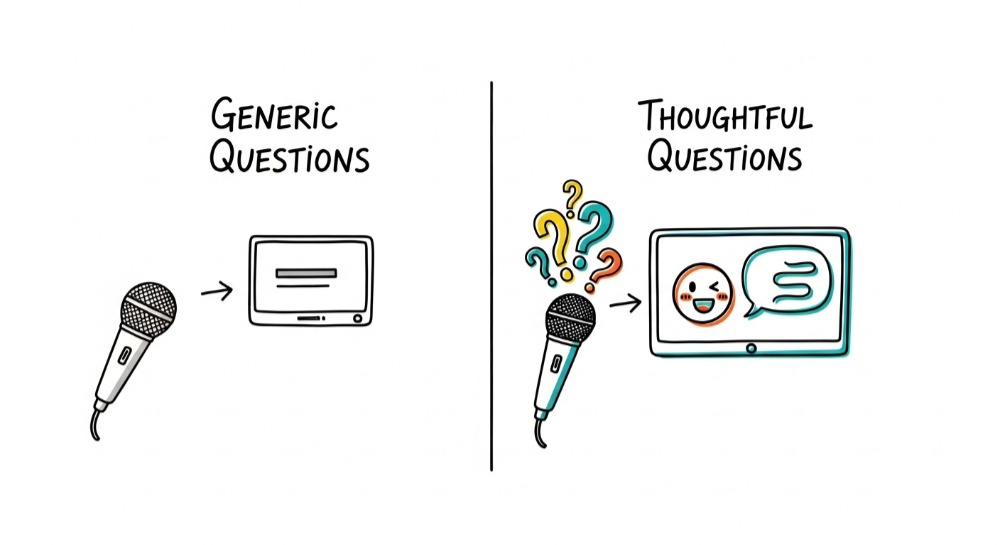
Step 3: Give them a prompt, not a script. Instead of telling customers what to say, give them three questions:
- What was the main problem you were trying to solve?
- What changed after you started using the product?
- Who would you recommend this to?
These three questions produce testimonials that are specific, credible, and structured — without sounding rehearsed.
Step 4: Follow up once. A single friendly reminder 48 hours later typically doubles response rates without damaging the relationship.
One agency owner reported collecting 11 video testimonials in a single week after implementing this framework — simply by emailing recent clients a Loom-style recording link with those three prompts. No editing required. The raw, natural footage performed better than any polished case study video they'd produced professionally.
Making Video Testimonials Work Across Your Entire Funnel
Collecting testimonials is only half the equation. Where and how you display them determines whether they actually move the needle.
Here's a quick deployment map:
- Homepage: One strong video testimonial above the fold or in a hero section builds immediate credibility for cold visitors.
- Pricing page: Pair video testimonials with specific ROI claims — "saved us 10 hours a week" hits differently next to a price point.
- Email sequences: Embed a thumbnail screenshot of a video testimonial in nurture or follow-up emails. Even static video thumbnails increase click rates significantly.
- Proposal documents: For agencies and consultants, a short testimonial video embedded in a proposal can tip decisions in your favor before the call even happens.
- Social media: Repurpose 30–60 second clips across LinkedIn and Instagram. Short customer success stories are among the highest-performing organic content formats right now.
Say About Us makes this distribution practical with embeddable widgets for Webflow, Framer, and Next.js, along with a Wall of Love feature that lets you curate and display your best testimonials in a visually compelling format — without needing a developer every time you want to update it.
Start Treating Testimonials Like a Revenue Asset
The gap between businesses that actively collect and deploy video testimonials and those that don't is becoming a meaningful competitive advantage. Text reviews build a baseline of credibility. Video testimonials build belief — and belief is what actually drives purchases.
If you've been waiting for the "right time" to invest in video testimonials, consider this your signal. The process doesn't require expensive production, a large customer base, or a marketing team. It requires a good product, a clear ask, and a system for making it easy.
Ready to build that system? Try Say About Us to start collecting and showcasing video testimonials today — alongside all the text reviews you've already earned.
Start collecting Testimonials with Say About Us on the free plan — no credit card required.
 Ask ChatGPT
 Ask Claude
 Ask Perplexity
 Ask Grok