You know you need testimonials. You know your customers are happy. But when it comes time to actually ask, something stops you.
Maybe it feels awkward. Maybe you're worried about seeming pushy. Maybe you've asked before and heard nothing back.
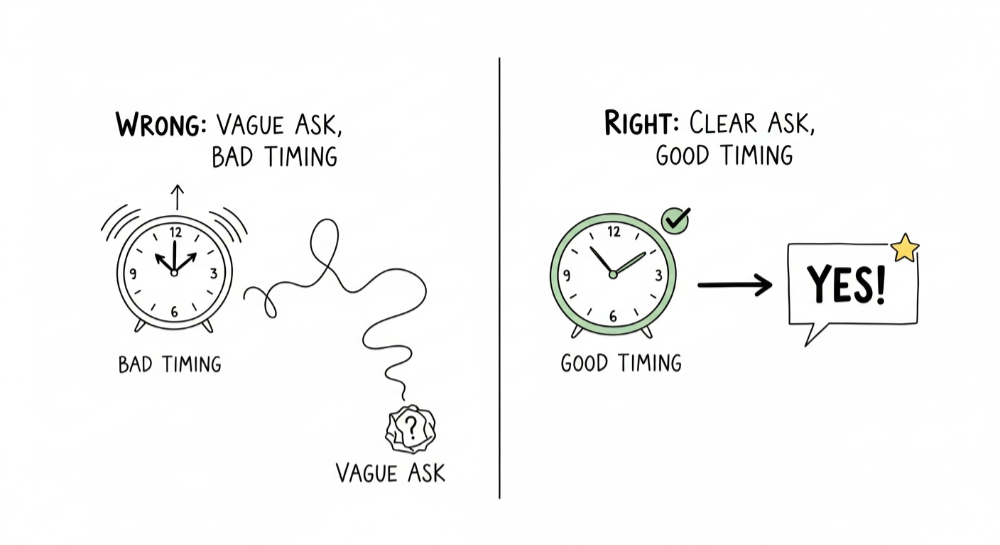
Here's the truth: asking for testimonials is a skill. And like any skill, it can be learned. The best testimonial request isn't about the perfect script — it's about asking the right person, at the right time, in the right way.
This guide covers all three. It's been updated for 2026 with the channels and formats that work best now — including short, low-friction asks that customers can answer from their phone in under a minute.
Why Most Testimonial Requests Fail
Before we get into what works, let's look at what doesn't.
The Generic Blast
Sending the same request to your entire customer list at the same time. Result: low response rates and generic testimonials from whoever bothers to reply.
The Awkward Ask
"Hey, would you maybe, if you have time, possibly consider leaving a testimonial? No pressure!" Result: the customer feels your discomfort and mirrors it.
The Buried Request
Hiding the ask in the middle of a long email about something else. Result: it gets skipped.
The Premature Ask
Requesting a testimonial before the customer has experienced real value. Result: either no response or weak, unconvincing praise.
The Psychology of the Ask
People are more likely to say yes when:
- They've recently experienced value — The positive feeling is fresh
- You make it easy — Low friction means higher completion
- They feel appreciated, not used — The request feels mutual, not extractive
- They know exactly what to do — Clear instructions beat open-ended asks
Every successful testimonial request leverages these principles. This is also why the data is so consistent: BrightLocal's research repeatedly finds that most consumers say they'll write a review if asked — the ask itself is the bottleneck, not the willingness. A request that hits the four points above converts far more of that goodwill into an actual testimonial.
When to Ask: The Timing Framework
Timing matters more than the perfect script. Here are the best moments. (If you're in a hurry, see our guide on the fastest way to collect testimonials during a launch.)
1. After a Win
The customer just achieved something with your help. They're excited. This is the highest-probability moment.
Trigger signals:
- They share good news in a call or email
- They hit a milestone (first month, first sale, first hire)
- They tell you something worked
2. After Praise
If they've already complimented you, asking for a testimonial is natural. They've done the hard part — now you're just capturing it.
Trigger signals:
- "This is amazing, thank you!"
- "I've already told three friends about you"
- Positive comments on a call
3. After a Referral
They've already recommended you to someone else. A testimonial is just a formalized version of what they're already doing.
4. At Key Milestones
Renewal, upgrade, project completion, or any natural checkpoint where the relationship deepens.
5. When They Engage
If they're opening your emails, using your product regularly, or responding to check-ins — they're engaged enough to help.
How to Ask: The Core Framework
Every effective testimonial request has three parts:
Part 1: Context
Remind them of the specific value they've received. This isn't bragging — it's jogging their memory.
"I saw you hit 500 subscribers last week..."
"Since we wrapped up the rebrand..."
"Now that you've been using the tool for 3 months..."
Part 2: The Ask
Be direct. Don't hedge, apologize, or bury it.
"Would you be open to sharing a quick testimonial?"
"I'd love to feature your experience on our site."
"Could I grab a short quote from you?"
Part 3: Make It Easy
Tell them exactly what to do. Give them a template, a link, or specific questions.
"Here's a quick form: [link]"
"A few sentences is perfect — here's a prompt if it helps: ..."
"Just hit reply with a few lines"
Scripts by Channel
Different channels need different approaches. Here's what works:
| Channel | Best for | Response dynamic |
|---|---|---|
| Formal requests, longer context | Good — allows detail, easy to ignore | |
| WhatsApp/SMS | Quick, warm, high-touch | Best for fast replies |
| B2B, professional network | Good — but requires existing connection | |
| In-person | After a live interaction | Highest conversion of all |
The channel matters less than the timing and the ease of the ask. A quick WhatsApp message timed to a win will outperform a perfect email sent a month late.
Email Request
Subject: Quick favor?
Hey [Name],
I noticed [specific recent success or milestone]. That's awesome.
I'm collecting stories from customers who've seen results like this. Would you be open to sharing a quick testimonial? It doesn't need to be long — a few sentences about what changed for you would be perfect.
Here's a simple prompt if it helps:
"Before [Product], I was ___. Now, I ___."
[Link to form or just ask them to reply]
Either way, thanks for being a customer.
[Your name]
WhatsApp/SMS Request
Hey [Name]! Quick question — would you be up for leaving a short testimonial about [specific thing]? A few sentences would be amazing. I can send a quick form or you can just reply here. No worries if not!
LinkedIn Request
Hey [Name], I'm putting together some customer stories and your [specific result/experience] came to mind. Would you be open to sharing a quick testimonial? Could be a LinkedIn recommendation or I can send you a simple form — whatever's easier for you.
In-Person Request
After a positive interaction:
"I'm so glad that worked out for you. Would you mind if I captured that as a testimonial? I can send you a quick form after this, or I can just write up what you said and send it for your approval."
Handling Common Objections
"I don't know what to say"
Solution: Give them a template or specific questions.
"No problem — here are a few prompts:
- What were you struggling with before?
- What's different now?
- Would you recommend us? To whom?"
"I'm too busy"
Solution: Make it even easier.
"Totally understand. Would a 2-minute voice memo work? Or I could draft something based on what you've told me and you just approve it?"
"Can I think about it?"
Solution: Set a soft follow-up.
"Of course! I'll check back in a week. If it helps, here's the form so you have it when you're ready."
Silence
Solution: One polite follow-up, then move on.
"Just bumping this in case it got buried. No pressure either way!"
Testimonial Request Mistakes to Avoid
Don't Apologize
"Sorry to bother you, but..." signals that your request is a burden. It's not.
Don't Be Vague
"Let me know your thoughts" is not a testimonial request. Be specific about what you're asking for.
Don't Ask Too Early
If they haven't experienced value yet, wait. A weak testimonial is worse than no testimonial.
Don't Make It Hard
Long forms, account creation requirements, complicated submission processes — all friction that kills response rates.
Don't Forget to Follow Up
Most people need a nudge. One polite follow-up can double your response rate.
Advanced Strategies
The Warm-Up Sequence
Before asking for a testimonial, engage them:
- Check-in email asking how things are going
- Wait for a response (ideally positive)
- Then ask for the testimonial
This feels conversational, not transactional. For a complete system that runs on autopilot, see how to collect testimonials without chasing people.
The Specific Ask
Instead of asking for a general testimonial, ask about one specific thing:
- "Would you mind sharing your experience with our onboarding?"
- "Could you describe what changed after our pricing conversation?"
Specific asks get specific (and more useful) responses.
The Reciprocal Ask
Offer something in return:
- A feature on your site with a backlink
- A shoutout on social media
- An extended discount or perk
This turns the ask into a mutual exchange.
The Video Option
Many customers prefer video to writing. Offer it as an option:
"If you'd prefer, a 30-second video is perfect. Just record on your phone and send it over."
For detailed strategies on collecting video testimonials specifically, read how to collect video testimonials without making it awkward.
After the Ask: What to Do With Testimonials
Getting the testimonial is step one. Using it effectively is step two:
- Confirm permission — Always ask if you can use their name, company, and photo
- Place strategically — Match testimonials to pages where they'll have the most impact
- Update regularly — Fresh testimonials beat stale ones
- Say thank you — A genuine thanks increases the chance they'll help again
Generate Your Request Scripts
Use our free Testimonial Request Generator to create personalized request scripts for any channel, tone, or situation. Select your audience, choose your platform, and get copy-ready messages in seconds.
Start collecting Testimonials with Say About Us on the free plan — no credit card required.


 Ask ChatGPT
 Ask Claude
 Ask Perplexity
 Ask Grok