Most testimonials are weak. Not because customers don't have good things to say — but because they don't know how to say them. A blank text box with "Leave a testimonial" is an invitation for generic praise that doesn't convert anyone.
Testimonial templates solve this. They give your customers a structure to follow, prompts to respond to, and the confidence to share specific, compelling stories about working with you.
This guide covers everything you need to know about testimonial templates: what they are, why they work, and how to use them across different industries.
What Is a Testimonial Template?
A testimonial template is a structured format that guides customers through writing a testimonial. Instead of asking "What do you think of us?", you provide a framework that pulls out the details that actually matter.
A basic template might look like this:
Before working with [Company], I was struggling with ___.
Now, I ___.
The biggest difference has been ___.
This simple structure does three things:
- Reduces friction — Customers don't have to figure out what to say
- Ensures specificity — The blanks force concrete details
- Creates narrative — Before/after stories are inherently compelling
Why Generic Testimonials Don't Convert
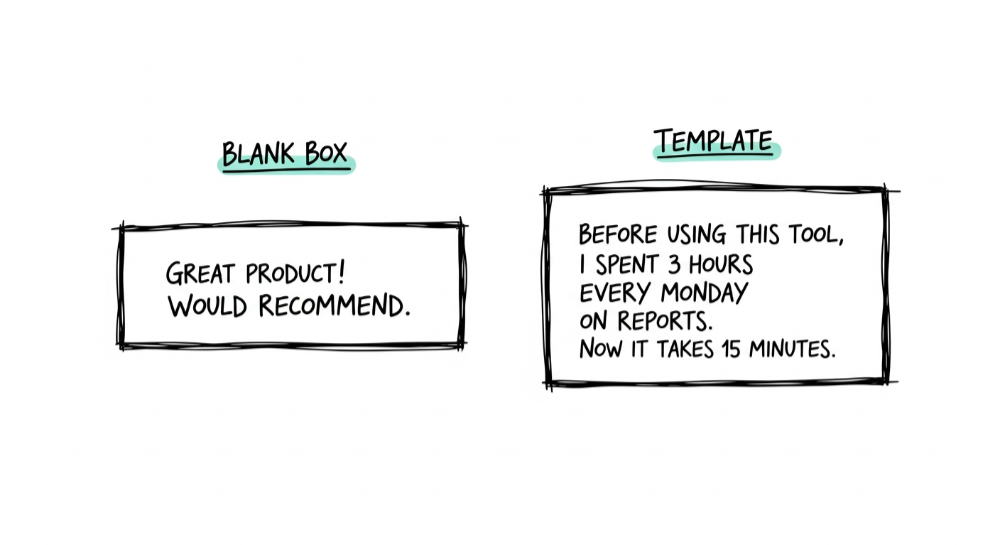
Here's a testimonial you've probably seen a hundred times:
"Great product! Would recommend."
It's positive. It's genuine. And it's completely useless for convincing anyone to buy.
Compare that to:
"Before using [Product], I was spending 3 hours every Monday manually updating our reports. Now it takes 15 minutes. My team actually looks forward to Monday standups because we have real data to discuss."
The second one works because it's specific, measurable, and relatable. Anyone who has wasted hours on manual reporting immediately sees themselves in that story.
Templates create the second type of testimonial consistently, even from customers who aren't natural writers.
The Core Elements of Effective Templates
Every strong testimonial template includes these elements:
1. The Before State
What was the customer's situation before they found you? What problem were they facing? What frustration were they experiencing?
Template prompt: "Before working with [Company], I was struggling with..."
2. The Decision Moment
Why did they choose you over alternatives? What made them take the leap?
Template prompt: "I decided to try [Company] because..."
3. The After State
What's different now? What results have they seen? How do they feel?
Template prompt: "Now, I..." or "The biggest change has been..."
4. The Specific Detail
Numbers, timeframes, and concrete outcomes. This is what makes testimonials believable.
Template prompt: "In [timeframe], I've seen..." or "The specific result was..."
5. The Recommendation
Would they recommend you? To whom? This creates social proof for specific segments.
Template prompt: "I'd recommend [Company] to anyone who..."
Testimonial Template Formats
Different situations call for different formats. Here are the main types:
| Format | Length | Best for | Core structure |
|---|---|---|---|
| Story template | 3-6 sentences | Case studies, landing pages | Before → alternatives → change → result → rec |
| Quick quote | 1-2 sentences | Widgets, email signatures | Result + recommendation |
| Metrics template | 1-3 lines | SaaS, B2B, results-driven | Before metric → after metric → timeframe |
| Objection-killer | 2-3 sentences | Pages where a specific fear lives | Worry → resolution → current state |
The Story Template
Best for: Case studies, landing pages, detailed proof
Before [Company], I was [pain point].
I tried [alternatives] but [why they didn't work].
Then I found [Company] and [what changed].
The biggest result has been [specific outcome].
I'd recommend them to [target audience] because [reason].
The Quick Quote Template
Best for: Social proof widgets, email signatures, quick validation
[One-sentence result] + [One-sentence recommendation]
Example: "Cut our onboarding time by 60%. If you're still doing this manually, you're wasting hours every week."
The Metrics Template
Best for: SaaS, B2B, results-driven industries
Before: [metric]
After: [metric]
Timeframe: [how long it took]
Example: "Before: 2% email open rate. After: 18% open rate. Timeframe: 6 weeks."
The Objection-Killer Template
Best for: Addressing specific concerns prospects have
I was worried about [common objection].
But [how that concern was addressed].
Now I [current positive state].
Example: "I was worried the learning curve would slow us down. But the team was productive within a week. Now we can't imagine going back."
Templates by Industry
Different industries need different approaches. Here's what works:
SaaS Companies
Focus on: Time saved, efficiency gains, measurable improvements
Template:
Before [Product], our team spent [X hours] on [task]. Now we [new workflow]. The ROI was clear within [timeframe].
Agencies
Focus on: Client results, communication, partnership feel
Template:
Working with [Agency] felt like having an extension of our team. They helped us [specific outcome], and the best part was [unexpected benefit].
Coaches & Consultants
Focus on: Transformation, mindset shifts, personal results
Template:
I came to [Coach] feeling [before state]. Through our work together, I [transformation]. The moment I knew things had changed was when [specific moment].
E-commerce
Focus on: Product quality, customer service, purchase decision
Template:
I was hesitant to buy [product type] online. But [what convinced them]. The [product] exceeded my expectations — especially [specific feature].
How to Deliver Testimonial Templates
The format matters, but so does the delivery. Here's how to actually get customers to use your templates:
Option 1: Embed in Your Request
Send the template directly in your email or message:
"Would you mind sharing a quick testimonial? Here's a simple format that works well:
Before working with us, I was ___. Now, I ___. The biggest difference has been ___."
Option 2: Use a Testimonial Collection Tool
Tools like Say About Us let you create custom forms with built-in prompts. Customers see the template, fill in the blanks, and you get a formatted testimonial automatically.
Option 3: Send Multiple Templates
Give customers options:
"Pick whichever format feels most natural:
- Quick version: One sentence about the biggest change
- Story version: What you were struggling with → what changed → what's different now
- Results version: Share any specific numbers or timeframes"
Common Template Mistakes
Mistake 1: Too Many Questions
Five questions feels like homework. Stick to 2-3 prompts maximum.
Mistake 2: Vague Prompts
"How was your experience?" leads to vague answers. Be specific: "What was the biggest surprise about working with us?"
Mistake 3: No Examples
Show customers what a good response looks like. Include a sample testimonial so they understand the tone and length you're looking for.
Mistake 4: Forgetting Permission
Always ask if you can use their testimonial publicly, with their name and company. Make this part of the template form.
Advanced Template Strategies
Once you have the basics, try these advanced approaches:
Segment-Specific Templates
Create different templates for different customer types. A template for enterprise clients should emphasize different outcomes than one for solopreneurs.
Video Testimonial Templates
Give customers a shot list:
- Introduce yourself (10 seconds)
- What problem were you facing? (20 seconds)
- What's different now? (20 seconds)
- Who would you recommend us to? (10 seconds)
Objection-Based Templates
Identify your top 3 sales objections and create templates that directly address each one. Then use these testimonials strategically on pages where those objections arise.
Using Your Testimonials Effectively
Collecting testimonials is half the battle. Placing them strategically is the other half:
- Homepage: Best for broad, impressive results
- Pricing page: Best for ROI and value testimonials
- Feature pages: Best for feature-specific testimonials
- Checkout: Best for trust and reassurance testimonials
Generate Your Templates Now
Creating testimonial templates from scratch takes time. Use our free Testimonial Template Generator to generate ready-to-use templates for your specific industry, audience, and goals.
The generator creates multiple template formats you can copy and send immediately — or use as a starting point for your own customized version.
Start collecting Testimonials with Say About Us on the free plan — no credit card required.
 Ask ChatGPT
 Ask Claude
 Ask Perplexity
 Ask Grok