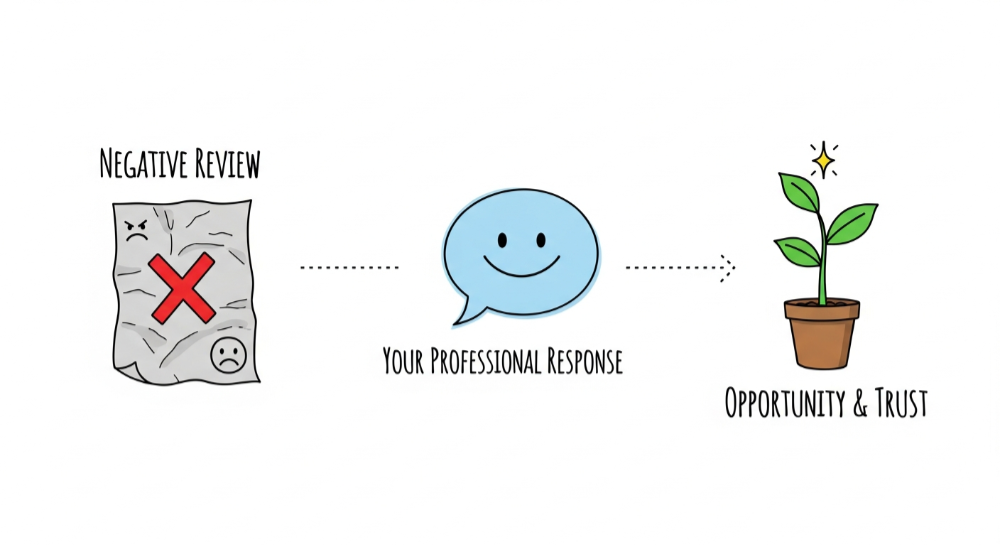
A negative review lands in your inbox. Your stomach drops. Your first instinct is to defend yourself, explain away the problem, or ignore it entirely.
Don't do any of those things.
Negative reviews, handled correctly, are opportunities. They show prospective customers how you handle problems. They give you feedback you might not hear otherwise. And sometimes — not always, but sometimes — they become your best recovery stories.
Here's how to respond to negative reviews professionally and effectively.
Why Negative Reviews Aren't the End of the World
Before we talk tactics, let's reframe:
1. Everyone Expects Some Negative Reviews
A business with only 5-star reviews looks fake. A few negatives add credibility — what matters is how you respond.
2. Prospects Judge Your Responses
82% of consumers read negative reviews specifically to see how businesses respond. Your reply is half the evaluation.
3. Recovery Builds Loyalty
Customers who have a problem resolved well often become more loyal than those who never had an issue. It's called the service recovery paradox.
4. It's Feedback
Some negative reviews reveal real problems you didn't know about. Use them.
The Negative Review Response Framework
Every response to a negative review should follow this structure:
1. Acknowledge
Show you read and understood their specific concern. This alone defuses a lot of anger.
2. Apologize
Apologize for their experience — not for being wrong (unless you were). There's a difference between "I'm sorry you're frustrated" and "I'm sorry we messed up."
3. Address
Respond to the specific issue. Don't make excuses, but do provide context if it helps.
4. Act
Tell them what you'll do to fix it or offer a path to resolution.
5. Move Offline
Provide a way to continue the conversation privately. Public threads rarely end well.
Templates for Common Negative Review Types
The Service Failure
Scenario: Something went wrong — late delivery, missed appointment, poor service
Hi [Name],
I'm sorry your experience didn't meet expectations. A [specific issue] is frustrating, and we should have done better.
I'd like to make this right. Please reach out at [email/phone] so I can personally address this. Your satisfaction matters to us.
[Your name]
The Product Problem
Scenario: Product didn't work as expected, quality issues, defects
Hi [Name],
Thank you for letting us know about this. I'm sorry [product] didn't perform as expected — that's not the quality we stand behind.
Please contact [support email] and we'll arrange a replacement or refund, whichever you prefer. We want to make this right.
[Your name]
The Communication Breakdown
Scenario: Customer felt ignored, had trouble getting help
Hi [Name],
I apologize for the communication issues you experienced. You're right — [waiting X days / not hearing back / etc.] is unacceptable.
I've looked into this and [brief explanation if helpful]. Please email me directly at [email] and I'll prioritize getting you the help you need.
[Your name]
The Pricing Complaint
Scenario: Customer feels overcharged or misled about pricing
Hi [Name],
I understand pricing concerns can be frustrating. Thank you for sharing your feedback.
[Brief clarification if there's a misunderstanding, or acknowledgment if they have a point]
If you'd like to discuss this further, please reach out at [email]. We want to make sure you feel the value is fair.
[Your name]
The Unmet Expectations
Scenario: Service/product wasn't what they expected
Hi [Name],
I'm sorry [product/service] didn't meet your expectations. It sounds like there was a gap between what you hoped for and what we delivered.
I'd like to understand where we fell short. Could you email [email] with more details? We take this feedback seriously and want to do better.
[Your name]
The Angry Rant
Scenario: All-caps, multiple exclamation points, clearly emotional
Hi [Name],
I can see you're frustrated, and I'm sorry for that. This clearly wasn't the experience we wanted you to have.
I'd like to discuss this directly and see how we can make it right. Please contact me at [email] — I'll personally look into this.
[Your name]
What NOT to Do
Don't Get Defensive
Bad: "Actually, if you had read the instructions..."
Good: "I'm sorry the setup was confusing — we're working on clearer documentation."
Don't Make Excuses
Bad: "We were short-staffed that day due to illness..."
Good: "I apologize for the delay. We should have communicated better."
Don't Blame the Customer
Bad: "Most customers don't have this problem..."
Good: "I understand your frustration. Let me see how we can help."
Don't Argue Publicly
Bad: "That's not true. Our records show..."
Good: "I'd like to look into this further. Please contact me directly at..."
Don't Ignore It
Silence looks like you don't care. A response — even a brief one — is always better than nothing.
Don't Use Generic Templates
Bad: "We're sorry you had a bad experience. Please contact support."
Good: [Personalized response addressing their specific concern]
Advanced Techniques
The Follow-Up
If you resolve the issue offline, ask if they'd consider updating their review:
Hi [Name],
I'm glad we were able to resolve [issue]. If you feel we've made things right, would you consider updating your review? No pressure — I just want others to know we take care of our customers.
Thanks again for giving us the chance to fix this.
[Your name]
The Pattern Recognition
Multiple negative reviews about the same thing? That's not bad luck — it's a signal. Fix the root cause, then respond:
Hi [Name],
You're not the first to mention [issue], and we're taking it seriously. We've [action taken] to prevent this from happening again.
Thank you for the feedback — it's helping us improve.
[Your name]
The Win-Back Offer
When appropriate, offer something tangible:
We'd love another chance to earn your business. I've [added credit / arranged a discount / etc.] to your account. We hope to see you again.
Use sparingly — don't train customers to leave bad reviews for freebies.
When the Customer Is Wrong
Sometimes they are. Maybe they didn't read the terms, or their issue is with something outside your control. You still need to respond professionally:
Clarify Gently
Hi [Name], thank you for your feedback. I'd like to clarify [factual correction]. That said, I understand this was frustrating for you. If you'd like to discuss further, please reach out at [email].
Redirect Without Arguing
I appreciate you sharing this. Based on what you've described, it sounds like [clarification]. I'd love to help resolve this — please contact [support] and we'll look into it together.
The goal isn't to "win" the argument publicly — it's to show future readers that you're reasonable and professional.
Responding Under Pressure
When you're angry or hurt by a review:
-
Wait before responding — Write a draft, then wait at least an hour. Often you'll revise it to be less defensive.
-
Get a second opinion — Have someone else read your response before posting.
-
Focus on the audience — You're not writing to convince the angry reviewer; you're showing future customers how you handle problems.
-
Remember the asymmetry — They can say anything; you need to be professional. It's not fair, but it's reality.
Generate Professional Responses
Use our Review Response Generator to create thoughtful responses to negative reviews. Describe the situation, select your tone, and get a professional response you can customize.
This article is part of our complete guide to How to Respond to Reviews.
Start collecting Testimonials with Say About Us on the free plan — no credit card required.
 Ask ChatGPT
 Ask Claude
 Ask Perplexity
 Ask Grok