⚡ Quick Answer: A client testimonial is a short, permissioned statement from a past or current client about the results you delivered — and for a consultant, it's the closest thing to a sales team you can own. To collect them as a consultant, ask immediately after delivering a win — not weeks later. Send a short, specific request with one or two guiding questions, and give clients a direct link to submit. Then store, manage, and display those testimonials somewhere prospects can actually find them.
Consultants win new work on trust, and a specific, third-party account of a delivered result is the strongest trust signal a prospect can get.
Why Most Consultants Never Get Good Testimonials
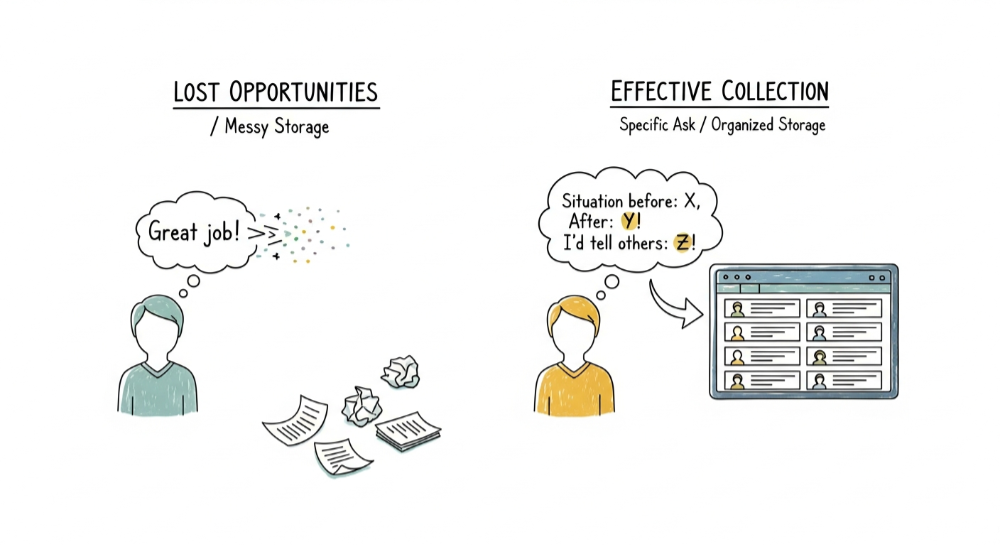
Most consultants have happy clients. They just never capture that happiness in a usable format.
The pattern is predictable: a client sends an enthusiastic email after a project wraps. You think, I should turn this into a testimonial. Three weeks have passed. The moment is gone.
The problem isn't reluctance — it's the system. There's no process for when to ask, how to ask, or where to put what you collect. So the social proof that should be working for you sits in an email thread nobody will ever read.
This guide fixes that.
When to Ask (Timing Is Everything)
The single biggest mistake consultants make: asking too late.
The right time to request a testimonial is within 48 hours of a meaningful win — a project milestone, a successful delivery, or a client saying something like "this was exactly what we needed."
That's the moment their experience is sharpest and their willingness is highest. Waiting until you're updating your website kills response rates because:
- The emotional peak has passed
- The client has moved on mentally
- It feels like a cold administrative request instead of a natural next step
If you missed the moment, the next best trigger is the end of an engagement — when you're doing a final recap or handoff call. Build the testimonial ask into your offboarding process so it's automatic, not afterthought.
How to Ask Without Being Awkward
Most consultants overcomplicate this. The ask doesn't need to be long or formal. It needs to be specific and low-friction.
Don't ask:
"Would you be willing to write a testimonial?"
Ask:
"Would you share a few sentences about the specific result we got on X? I'd love to use it on my website."
Specificity removes the blank-page problem. Clients don't know what to write — give them a starting point.
The Email Template That Works
Subject: Quick favour — would you share your experience?
Hi [Name],
Really glad we hit [specific result] on [project]. It was great working with you.
I'm building out some testimonials for my website and would love to include your perspective. Would you be willing to answer two quick questions?
1. What was the situation before we worked together, and what changed?
2. What would you tell someone considering working with me?[Link to your testimonial form]
Takes 5 minutes — and I genuinely appreciate it.
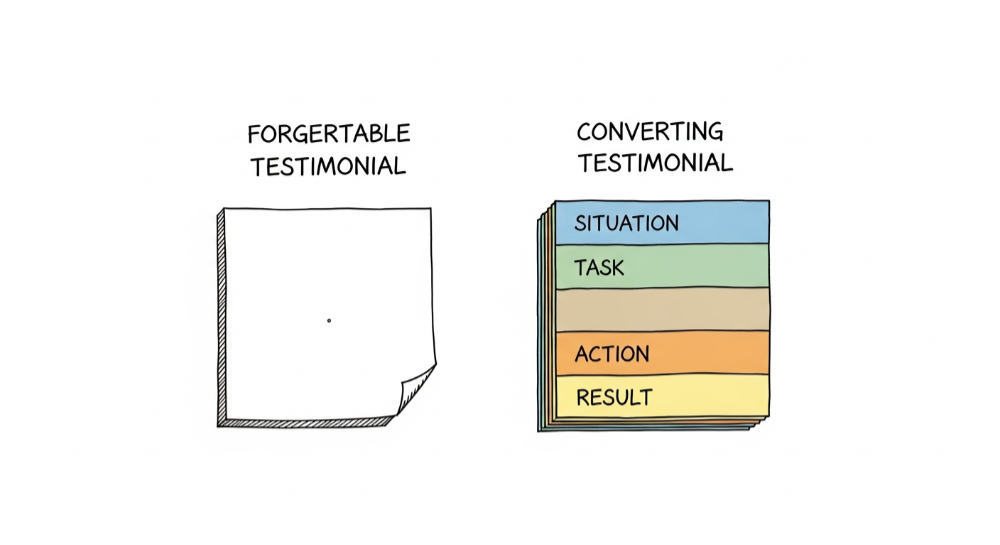
The two-question format works because it produces a before/after structure that prospects find credible and specific.
How to Collect, Manage, and Display Them in One Place
Collecting testimonials via email is fine for asking. It's a mess for managing.
What most consultants end up with: screenshots in a folder, quotes buried in email threads, a few copy-pasted lines in a Google Doc. Nothing is searchable, nothing is embeddable, and nothing is easy to update.
A better approach is to use a dedicated tool that handles the full workflow — collection form, central dashboard, and embeddable display — without you having to stitch together three different tools.
Say About Us was built exactly for this. You get a branded collection page you can send to clients directly, a single place to manage every testimonial you receive, and embeddable widgets you can drop onto your website or landing pages. Unlimited testimonials, no caps.
According to the BrightLocal Local Consumer Review Survey 2026, 45% of consumers now use AI to find local business recommendations. That means your testimonials need to be structured and publicly visible — not buried in a PDF or hidden in a footer. A dedicated testimonial page that's indexable by search engines and AI tools is no longer optional.
Where to Showcase Your Testimonials for Maximum Impact
Collecting testimonials is half the job. Placement determines whether they actually convert.
The highest-impact locations:
- Homepage — above the fold or in the hero section, not buried at the bottom
- Services or work-with-me page — where buying decisions happen
- Proposal documents — 2–3 targeted testimonials relevant to the prospect's industry
- LinkedIn profile — the Featured section is underused by most consultants
- Email signature — a rotating quote builds credibility passively
The goal is to put social proof at every decision point — not just on a dedicated testimonials page that nobody visits.
Say About Us makes this practical with embeddable widgets that update automatically when you add new testimonials. Add it once, keep it current.
What Makes a Consultant Testimonial Credible?
Not all testimonials are equal, and prospects know it. The difference is specificity:
| Weak testimonial | Strong testimonial |
|---|---|
| "Great to work with, highly recommend." | "They helped us cut our reporting process from 3 days to 4 hours." |
| "Very knowledgeable." | "Their pricing work added 12% to our close rate in one quarter." |
| "Would definitely hire again." | "We re-engaged them for a second project within 60 days." |
Specific testimonials convert because they give the prospect a concrete outcome to imagine. Vague praise could describe anyone; a specific result describes you — which is exactly what a prospect comparing consultants needs to see.
Start collecting Testimonials with Say About Us on the free plan — no credit card required.
 Ask ChatGPT
 Ask Claude
 Ask Perplexity
 Ask Grok