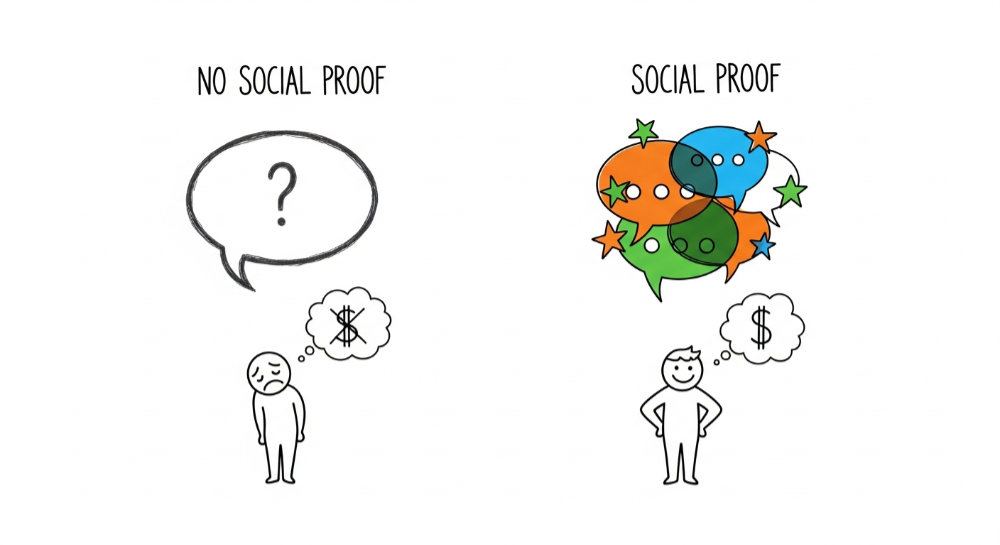
B2B social proof refers to the reviews, testimonials, and ratings that influence whether a buyer trusts a business enough to engage. A 2026 survey by GoodFirms across 552 professionals in 25+ countries found that 97% of purchase decisions are influenced by online reviews. For B2B businesses, social proof operates in two distinct layers: third-party review platforms (where buyers find you) and owned testimonials on your website (where buyers decide on you). You need both.
The Problem Nobody Talks About
You spend hours crafting the perfect cold email. You follow up. You refine your pitch.
And then... nothing.
Because the person on the other end Googled you — and didn't like what they found. Or worse: found nothing at all.
That's the real issue. Most B2B businesses pour time into outreach while completely ignoring the thing that actually determines if a stranger will trust them. Social proof is the invisible sales layer that runs before you ever get on a call.
Here's the data that stopped me in my tracks: GoodFirms surveyed 552 professionals across 25+ countries and found that 97% of purchase decisions are influenced by online reviews.
97%.
Which means if your reviews are weak — or scattered, or missing — you're losing deals you don't even know you lost.
What Is B2B Social Proof?
B2B social proof is the collection of reviews, ratings, testimonials, case studies, and third-party endorsements that tell potential buyers: other people have worked with this company and it went well.
It's the digital equivalent of word-of-mouth. Except it works 24/7, even when you're not in the room.
In a B2B context, social proof shows up in two places — and most businesses only think about one of them.
The Two Layers of B2B Social Proof
Think of B2B social proof as a two-layer system.
Each layer serves a different job in the buyer's journey. Ignoring either one leaves money on the table.
Layer 1: The Discovery Layer (Where Buyers Find You)
This is where your buyers go to shortlist vendors. Before they ever land on your website, they're checking platforms they already trust.
Think GoodFirms, G2, Clutch, Google Business. These are the directories where buyers filter by category, read reviews, and decide who's worth talking to.
Your presence here — and your review count — determines whether you make the shortlist.
If your profile is empty or has two reviews from 2022, you're getting skipped. Not consciously. Just quietly.
What matters at this layer:
- Review volume (more is better, up to a point)
- Recency (a 2021 review is a red flag in 2026)
- Response to reviews (it signals you're active and accountable)
Layer 2: The Conversion Layer (Where Buyers Decide on You)
This is your website. Your landing page. The place a buyer lands after they've found you and want to verify you're legit.
Here, third-party reviews aren't enough. Buyers want to see real words from real customers in context. Specific outcomes. Specific situations that match their own.
This is where owned testimonials do the heavy lifting — short video testimonials, written quotes, before/after stories that map directly to the buyer's problem.
If your website has no testimonials, or generic ones from 2019, you're creating doubt at exactly the wrong moment.
Why Most B2B Businesses Only Handle One Layer
Most businesses either:
-
List on a directory and forget it — they get a Clutch profile, maybe collect a few reviews, then move on. The website stays empty.
-
Add a testimonials page and never update it — a "What our clients say" section that's been the same for three years.
Neither is a strategy. Both are passive.
The businesses winning at B2B social proof are treating it like a system. Proactively collecting reviews on directory platforms. Simultaneously capturing testimonials from customers and publishing them directly on their site.
One layer gets you found. The other layer gets you chosen.
| Layer 1: Discovery | Layer 2: Conversion | |
|---|---|---|
| Where | G2, Clutch, GoodFirms, Google | Your website, pricing page |
| What buyers do | Shortlist vendors, filter by category | Verify, compare, decide |
| What wins | Review volume, recency, responses | Specific, contextual testimonials |
| Ownership | The platform owns the reviews | You own the testimonials |
| Cost of neglect | You never make the shortlist | You make the shortlist but lose the deal |
How the Two Layers Work Together
Here's what this looks like in practice for a B2B service company or SaaS business:
-
Create your profile on review platforms. Start with the directories your buyers actually use. GoodFirms covers IT services, software, and agencies with strong global reach. G2 is strong for SaaS. Clutch for agencies.
-
Ask for reviews systematically. Don't wait for happy customers to review you spontaneously. Build a post-project or post-onboarding ask into your process. Make it frictionless — one link, one click.
-
Collect testimonials for your own website separately. Reviews on directories are owned by the directory. Your website testimonials are owned by you. Both matter, but only one you fully control. Use a tool like Say About Us that lets customers leave a quick text or video testimonial without creating an account.
-
Publish testimonials on your site in context. Don't dump them all on one page. Put them near the decision point — on your pricing page, your homepage hero, your product features section. The right testimonial next to the right content removes doubt at the exact moment it exists.
-
Keep it moving. Stale social proof is almost as bad as none. Set a quarterly reminder to refresh. Aim for at least one new testimonial per month.
Who Should Prioritize Which Layer?
This depends on where you are.
-
Early stage (0–20 customers): Focus on Layer 2 first. You likely don't have enough reviews for a directory to help you, but even 3–5 strong testimonials on your website can dramatically improve conversion. Personal social proof beats volume when you're small.
-
Growing (20–100 customers): Start building Layer 1. You now have enough customers to gather reviews on platforms. A profile with 10+ genuine reviews starts generating inbound trust without any extra effort.
-
Established (100+ customers): You need both layers actively maintained. At this stage, neglecting either one costs you more than you think. Buyers at this level do deeper research — they check directories and your website.
Final Verdict
B2B social proof isn't a single thing you set up once.
It's a two-layer system: one layer on the platforms where buyers discover you, another on your own website where they decide to trust you.
Most businesses handle one. The ones who handle both win more quietly — no extra outreach required, no pricing changes, no new positioning. Just better evidence already in place by the time a buyer shows up.
If your review platforms are bare, start there. If your website testimonials are outdated or generic, start there. If both need work, start with whichever layer your buyer is more likely to check first.
Start Small
You don't need a full system on day one.
Pick one customer this week. Ask them for a review on whichever platform matters most for your category. Then ask them if they'd leave a quick quote for your website too.
That's two pieces of social proof from one conversation.
Do that consistently, and the layer builds itself.
For the questions that get B2B customers talking, check out our B2B testimonial questions guide. It's designed specifically for enterprise and team-based products.
Shashank
Co-Founder of Say About Us
Start collecting Testimonials with Say About Us on the free plan — no credit card required.
 Ask ChatGPT
 Ask Claude
 Ask Perplexity
 Ask Grok