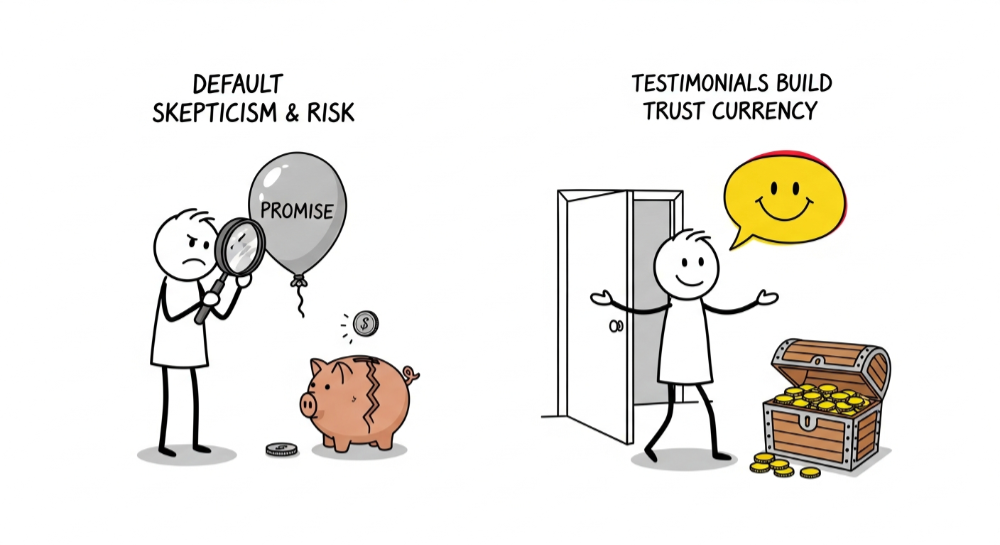
The internet runs on a trust deficit.
Every day, your customers are bombarded with scams, dropshipping schemes, and "get rich quick" ads. Their default state is skepticism. When they land on your website, they are not looking for reasons to buy; they are looking for reasons not to buy.
They are looking for the catch.
Testimonials are the only way to disarm that skepticism. They shift the narrative from "Company promises result" to "Real person confirms result."
The Psychology: Why Testimonials Work
1. The "Zero-Risk" Bias
Psychologically, people hate risk more than they love gain. We will work harder to keep $10 than to earn $10. This is called loss aversion — a concept first formalized by psychologists Daniel Kahneman and Amos Tversky in their 1979 paper on prospect theory.
When a visitor sees your pricing page, they feel risk:
- "What if this doesn't work?"
- "What if I waste my money?"
- "What if it's harder than they say?"
Testimonials act as an insurance policy for their decision. When they see someone else—someone who looks like them—using the product successfully, the perceived risk drops. It gives them permission to believe you.
2. Social Proof
We look to others to validate our decisions. If 1,000 people bought something and are happy, it's probably safe. If no one is talking about it, something might be wrong.
Effective social proof includes:
- Number of customers ("Join 5,000+ users")
- Recognizable logos ("Used by...")
- Specific testimonials from real people
- Star ratings and review counts
3. The Similarity Principle
People trust testimonials from people who are like them. A SaaS founder trusts other SaaS founders. A course creator trusts other course creators.
This is why testimonial context matters:
- Include job titles and industries
- Show company logos when possible
- Highlight use cases that match your target audience
Specifics Build Credibility
Vague trust is weak trust.
| Weak Testimonial | Strong Testimonial |
|---|---|
| "Great service!" | "They replied in 4 minutes on a Sunday" |
| "Saved me time" | "Cut my weekly reporting from 3 hours to 20 minutes" |
| "Worth every penny" | "Paid for itself in the first week with one closed deal" |
Trust is built on specifics. The more detailed the testimonial, the more authentic it feels.
This is why we push for video. It is impossible to fake the specific details of a user's facial expression and tone of voice.
Where Trust Matters Most
Place testimonials where doubt is highest:
| Page | Buyer's Doubt | Testimonial Focus |
|---|---|---|
| Homepage | "Is this legit?" | Credibility, volume |
| Pricing | "Is it worth it?" | ROI, value |
| Checkout | "Should I really do this?" | Risk reversal, quick wins |
| Features | "Does this actually work?" | Specific use cases |
How Many Testimonials Do You Actually Need?
There's no magic number, but there is a pattern: the bar rises with price and risk. A $9 impulse buy needs less proof than a $9,000 contract.
- Low price / low risk: 3-5 testimonials on the landing page is usually enough to beat skepticism.
- Mid price / considered purchase: 10+ with variety — different roles, industries, and use cases.
- High price / B2B: testimonials alone aren't enough; pair them with case studies, logos, and numbers.
The common thread isn't quantity — it's specificity and similarity. One testimonial from a company that looks exactly like your prospect beats twenty generic ones. If you're not sure how many to display, see how many testimonials a website should have for a fuller breakdown.
Trust is Currency
Trust is the currency of the internet. If you have it, you can sell anything. If you don't, no amount of ad spend will save you.
Stop trying to "growth hack" your way to sales. Build trust, and the sales will follow.
For a complete trust-building system beyond testimonials, read our website trust building framework. To see examples of specific, believable testimonials that build trust, browse our testimonial examples guide.
Want to audit your website's credibility? Check out our Website Trust Score Guide and use our free Trust Score Checker tool.
Start collecting Testimonials with Say About Us on the free plan — no credit card required.
 Ask ChatGPT
 Ask Claude
 Ask Perplexity
 Ask Grok